Video creator
A creator drafts a short narration for a clip and wants to hear whether the words fit the intended scene.
A spoken draft makes awkward timing and hard-to-say phrases easier to catch before editing the video.
Voice basics
If you are asking what is fish audio ai voice, the short answer is that Fish Audio refers to an AI voice service: a way to turn written words into spoken audio. The useful distinction is between the words you supply, the voice used to read them, and the recording you hear at the end. This guide explains that process without assuming that every voice service offers the same controls or permissions.

Fish Audio searches can point to several different questions. These nearby guides separate the general idea from a specific task.
Calling something an AI voice tool describes its purpose, not a guarantee about every recording it produces.
A voice can read an incorrect name, date, or claim convincingly. Fish Audio output should not be treated as fact-checking.
What to do instead
Check the text against a reliable source before turning it into speech.
A voice resembling a real person raises consent and usage questions that audio generation alone cannot settle.
What to do instead
Use a voice you have permission to use and review the applicable terms.
Names, abbreviations, emphasis, and pauses may sound different from what the writer intended.
What to do instead
Listen to the entire result and revise the script where pronunciation or pacing misses the mark.
The basic AI voice workflow starts with text and ends with audio, with a listening pass in between.
Write a short script with punctuation that reflects how it should sound. Spell out an abbreviation if its spoken form matters, and keep sentences easy to hear rather than merely easy to scan.
A voice setting, where available, affects the character of the reading. Choose for the audience and subject instead of assuming that a dramatic sample will suit every script.
The system produces speech from the text. Play it back, check meaning and pronunciation, then edit the words or available settings before using the recording.
This comparison separates the information a writer supplies from the result an AI voice system can produce.
| Written script | Generated speech | |
|---|---|---|
| Main form | Words that a reader sees | Words that a listener hears |
| Starting material | Drafted or edited text | A script supplied for spoken delivery |
| Pronunciation | May be ambiguous on the page | Becomes audible and needs checking |
| Pacing | Suggested by sentence length and punctuation | Heard as pauses and speaking rhythm |
| Factual accuracy | Depends on the writer's research | Still depends on the writer's research |
| Permission | Rights to the text must be considered | Rights to the text and voice must be considered |
The change is in how the same message is experienced: readers set their own pace, while listeners hear a particular delivery.
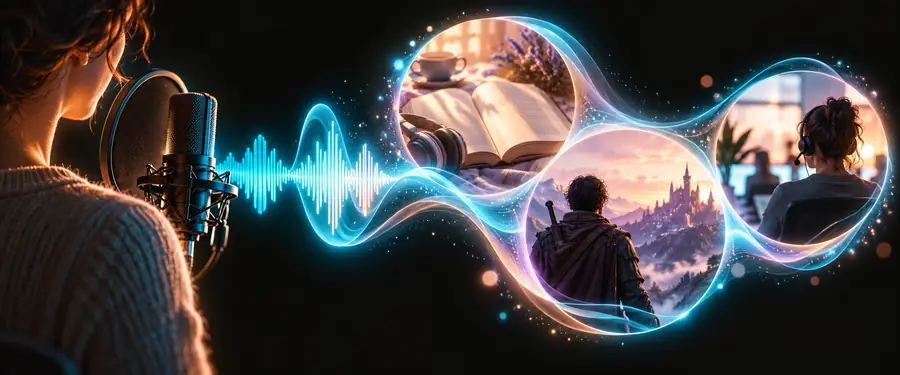
These illustrations show the idea of text becoming speech; they are not a verified before-and-after recording from Fish Audio.
Written wordsSpoken deliveryAI voice is useful when listening serves the audience better than another block of text, provided the script and voice are appropriate.
A creator drafts a short narration for a clip and wants to hear whether the words fit the intended scene.
A spoken draft makes awkward timing and hard-to-say phrases easier to catch before editing the video.
A storyteller needs a compact opening that is understandable when heard without captions.
Listening reveals whether the hook makes sense at normal speaking pace.
A researcher has one script and wants to judge how different services handle the same wording.
Using identical text makes pronunciation, pacing, and overall fit easier to compare.
Before trying a voice tool, write the message, confirm any claims, and decide whose voice you have permission to use. Then listen critically to the result rather than judging it from a short preview alone.
It refers to using AI to create spoken audio from text in a Fish Audio context. The phrase describes the general voice-generation task; it does not, by itself, establish which controls or rights a particular service provides.
No. Generated speech is produced by a system from supplied text, while a human recording captures a person speaking. Both need a listening review, but generated speech may need extra attention to unexpected pronunciation or emphasis.
Do not assume it does. A believable voice can still speak an inaccurate sentence, so the writer should verify names, numbers, and claims before using the audio.
Do not assume that a voice being available means you have permission to use it. Check consent, the rights attached to the voice, and the terms that apply to your intended use.
Listen to the full passage rather than a single appealing line. Check names, pauses, emotional fit, and whether a listener can follow the meaning without seeing the text.